[COMPARTMENTED] Decoding Trump’s Saudi Maneuvers
Global Power Plays and Proxy Signals: Decoding Trump’s Saudi Maneuvers

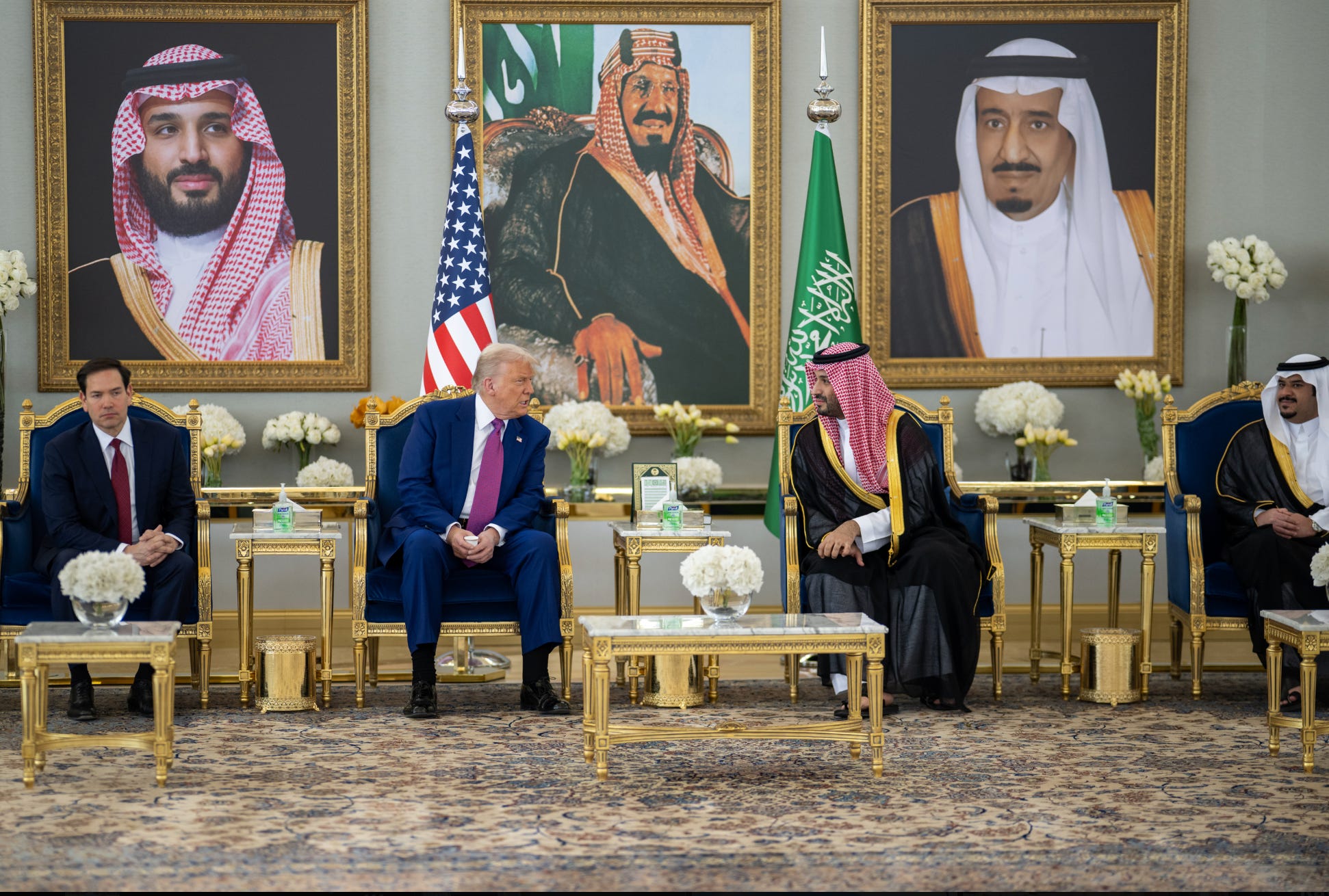
President Trump’s Saudi Arabia visit wasn’t a diplomatic courtesy call. It was a calculated recalibration of U.S. influence in the Gulf. The $600 billion investment package, anchored by a $142 billion arms deal, isn’t merely economic statecraft. It’s a deliberate escalation of regional hard power, cloaked as cooperative prosperity.
This wasn’t a transaction. It was a strategic prepositioning.
THE ARMS ESCALATION
The hardware in play isn’t routine. THAAD batteries, Patriot PAC-3 interceptors, and MQ-9B SeaGuardian drones indicate a pivot from standard defense to robust, layered counter-drone and missile architectures. These systems are tailored to neutralize high-density aerial threats. Think Iranian drone swarms or H formule attack patterns akin to the 2019 Aramco strikes.
C-130J Super Hercules transports in the mix aren’t defensive assets. They’re enablers of rapid force deployment and covert logistics, potentially staging for contested zones. Whispers of F-15EX enhancements point to a broader spectrum of air superiority upgrades, timed with escalating tensions along Israel’s northern frontier.
DATA DOMINANCE OR DIGITAL DEPENDENCY?
The $80 billion tech package—centered on AI, cloud infrastructure, and data systems—implicates U.S. firms like Oracle, Google, and Salesforce. Superficially, it’s a commercial win. Beneath the surface, it’s a gamble on operational security and regional leverage.
AI-driven ISR, predictive drone orchestration, and integrated data frameworks straddle civilian and military applications. If Saudi Arabia gains deeper access to these systems’ architecture, the U.S. risks ceding control over critical strategic tools. The real question: who will own the decision loops in regional data hubs? Those hubs could dictate targeting priorities, threat assessments, and even autonomous strike logic. A Gulf-based digital backbone for U.S. warfighting tech could erode the distinction between partner and proxy.
SYRIA’S OPENING: DIPLOMACY OR GEOSTRATEGIC CHESS?
Trump’s move to lift U.S. sanctions on Syria and engage interim President Ahmed al-Sharaa is pitched as reconciliation. In reality, it’s a maneuver to counterbalance Turkish, Iranian, and Russian inroads. This isn’t about rebuilding Syria—it’s about securing influence over eastern Mediterranean energy corridors, disrupting Russian logistics, and bolstering Israeli airspace security.
If Saudi Arabia quietly nudges Syria toward Israel’s orbit, expect the contours of a Sunni counterweight to Iran, stretching from the Gulf to the Levant. This is less about peace than pipelines and power projection.
ABRAHAM ACCORDS: PEACE PACT OR MILITARY ALIGNMENT?
Trump’s push for Saudi inclusion in the Abraham Accords dangles formal recognition of Israel for security and economic concessions. No deal is inked, but the subtext is clear: this isn’t about handshakes. It’s about forging a Gulf-Israel security axis.
Expect integrated radar networks, drone interoperability, and shared logistics hubs. Picture Iron Dome batteries in Jeddah, cyber task forces in Tel Aviv, or U.S.-linked missile tracking stations in Dubai. Iran’s ballistic arsenal is the unspoken target, with U.S. systems as the connective tissue.
DOCTRINAL BET: FROM COMBAT TO CONTROL
Trump’s strategy isn’t a retreat from conflict—it’s a wager on containment through tech and trade. It swaps ground troops for digital infrastructure, combat roles for enabling frameworks. The U.S. is doubling down on influence via contracts, code, and cloud architecture, not occupation.
The risks are stark. Ethical hazards arise from empowering regimes with spotty governance records. Tactical vulnerabilities emerge from exporting tech that could be repurposed or reverse-engineered. Strategically, treating the region as a ledger ignores its volatility.
Yet the signal is unmistakable: the U.S. is reasserting dominance, not by boots but by bytes, not by bases but by bargains.
SOURCE CLASSIFICATIONS:
Open-source ISR aggregates (GUR/X-derived OSINT)
Peripheral SIGINT media analysis
Historical analogs: 2019 Aramco attack, 2022 Negev Summit
Comparative frameworks: U.S.-Taiwan arms dynamics (2020–2024)
Per The White House:
Here are the top moments:
“Exactly eight years ago this month, I stood in this very room and looked forward to a future in which the nations of this region would drive out the forces of terrorism and extremism … and take your place among the proudest, most prosperous, most successful nations anywhere in the world as leaders of a modern and rising Middle East.” (Watch)
“Before our eyes, a new generation of leaders is transcending the ancient conflicts and tired divisions of the past, and forging a future where the Middle East is defined by commerce, not chaos; where it exports technology, not terrorism; and where people of different nations, religions, and creeds are building cities together — not bombing each other out of existence.” (Watch)
“This great transformation has not come from Western interventionists … giving you lectures on how to live or how to govern your own affairs. No, the gleaming marvels of Riyadh and Abu Dhabi were not created by the so-called ‘nation-builders,’ ‘neo-cons,’ or ‘liberal non-profits,’ like those who spent trillions failing to develop Kabul and Baghdad, so many other cities. Instead, the birth of a modern Middle East has been brought about by the people of the region themselves … developing your own sovereign countries, pursuing your own unique visions, and charting your own destinies.” (Watch)
“In the end, the so-called ‘nation-builders’ wrecked far more nations than they built — and the interventionists were intervening in complex societies that they did not even understand themselves.” (Watch)
“After so many decades of conflict, finally it is within our grasp to reach the future that generations before us could only dream about — a land of peace, safety, harmony, opportunity, innovation, and achievement right here in the Middle East.” (Watch)
“I am here today not merely to condemn the past chaos of Iran’s leaders, but to offer them a new path and a much better path toward a far better and more hopeful future.” (Watch)
“As I have shown repeatedly, I am willing to end past conflicts and forge new partnerships for a better and more stable world, even if our differences may be very profound.” (Watch)
“My preference will always be for peace and partnership, whenever those outcomes can be achieved. Always.” (Watch)
“In recent years, far too many American presidents have been afflicted with the notion that it’s our job to look into the souls of foreign leaders and use U.S. policy to dispense justice for their sins … I believe it is God’s job to sit in judgement — my job [is] to defend America and to promote the fundamental interests of stability, prosperity, and peace.” (Watch)
“Following repeated attacks on American ships and freedom of navigation in the Red Sea, the United States military launched more than 1,100 strikes on the Houthis in Yemen. As a result, the Houthis agreed to stop … We hit them hard, we got what we came for — and then we got out.” (Watch)
“My administration stands ready to help Lebanon create a future of economic development and peace with its neighbors.” (Watch)
“In Syria, which has seen so much misery and death, there is a new government that will hopefully succeed in stabilizing the country and keeping peace.” (Watch)
“If the responsible nations of this region seize this moment, put aside your differences and focus on the interests that unite you, then all of humanity will soon be amazed at what they will see right here in this geographic center of the world … and the spiritual heart of its greatest faiths.” (Watch)
FOR INTERNAL DISSEMINATION
Request encrypted annex on procurement schedules or divisional breakdowns if needed.
Trust your instincts. Not the television. - The SCIF